Spectacle repairs make good sense
Why a repair can make good sense
When glasses break, most people think buying a new pair is the only option. But in our experience, that's often not true. Repairs make sense more often than you might expect, especially if the frame fits well, the lenses are fine, and the damage is minor and fixable.
A loose screw, a bent arm, a popped lens, or a broken nose pad might seem like a big problem at first. But these are the kinds of issues a skilled repair team can usually fix. Even if the frame looks worn, it might still be strong underneath.
This matters because glasses are precision tools, not just accessories. When a frame fits well, the lenses sit correctly, and you feel comfortable all day. If you throw away a frame too soon, you lose that fit and comfort. That's why we suggest pausing before replacing your glasses to see if a repair could make them safe and reliable again.
There is also a clear financial reason to repair. AlphaOmega's repair prices show that many common fixes cost between £30 and £40, with specialist work costing more if needed. In comparison, replacing your glasses often means buying a new frame and sometimes new lenses as well. While repair is not always the cheapest option, it often is, especially if the frame is worth keeping.
There is an emotional side as well. Clients often tell us they love a pair because it suits their face, feels comfortable, or has sentimental value. These are good reasons to repair instead of replace when possible. A careful repair can make a favourite pair usable again without changing what made it special.
The important thing is knowing when repair is the smarter choice and when replacement makes more sense. This depends on the type of damage, the frame's condition, the lenses' condition, and the overall value of the glasses.
What makes a repair worth it
The strongest case for repair is usually a simple mechanical problem. Loose screws, bent temples, worn nose pads, a hinge that has come apart or a lens that has popped out are common faults that can usually be put right without replacing the entire pair.
Repair also makes sense if the frame is expensive, hard to replace, or discontinued. Designer eyewear, premium titanium frames, and older styles that are no longer sold are good examples. People often want to keep these because a similar replacement would cost more or because the frame fits better than anything else they've worn.
Comfort is another important factor. Some frames feel perfect from the start. They sit well on your nose, stay in place, and feel balanced all day. If a pair like this breaks but can be repaired, keeping that good fit can be more valuable than starting over with something new.
Repair can also be the best option when damage is limited to one component rather than the whole pair. A broken temple does not automatically mean the frame front is useless, and a damaged bridge does not always mean the lenses need to be scrapped. NHS guidance on the repair or replacement of glasses recognises that separate parts of a frame may be repaired or replaced independently, reflecting the practical way most eyewear failures occur.
There is also a sustainability benefit. Repairing a good pair of glasses means less waste goes to landfill and there is less need for new manufacturing. Many customers say this is just as important to them as saving money.
When replacement is the better choice
Repair is not always the answer. If the frame has a deep crack across the bridge, a broken rim, repeated hinge problems, or is badly warped, it may not be stable enough to wear safely.
Damaged lenses are another major factor. Scratches, cracks and chips can interfere with vision, create glare and reduce comfort. If the lenses are no longer clear enough to do their job, replacement is often the right answer, especially when a prescription change is due anyway.
We also suggest replacement when the repair cost is close to the price of a new pair. Repairs costing £30 to £40 can be great value, but more complex work can get much more expensive depending on the frame and the damage. If the frame is cheap and easy to replace, or the repair is highly specialised, a new pair may be a better choice in terms of cost, reliability, and convenience.
Age and build quality are important too. Some cheap frames are not made for repeated repairs. Thin plastic, weak hinges, or poor plating can cause one problem to lead to another. The situation matters as well. If the frame is comfortable but your prescription is outdated, replacing the glasses may solve both issues. If the lenses are fine but the frame can't be fixed, reglazing or moving the lenses to a new frame might be better. The best choice depends on the whole pair, not just the broken part.
YOUR EYEWEAR DESERVES EXPERT CARE
Real replacement parts. Real results. Real fast.
CALL ALPHAOMEGA
How we assess a repair
When glasses arrive at our workshops, we do not just look at the obvious break. We check the whole structure, because one problem can often hide another. For example, a bent arm might have loosened the hinge, a cracked bridge could have stressed the lens rim, or a missing nose pad might have changed how the frame sits on your face.
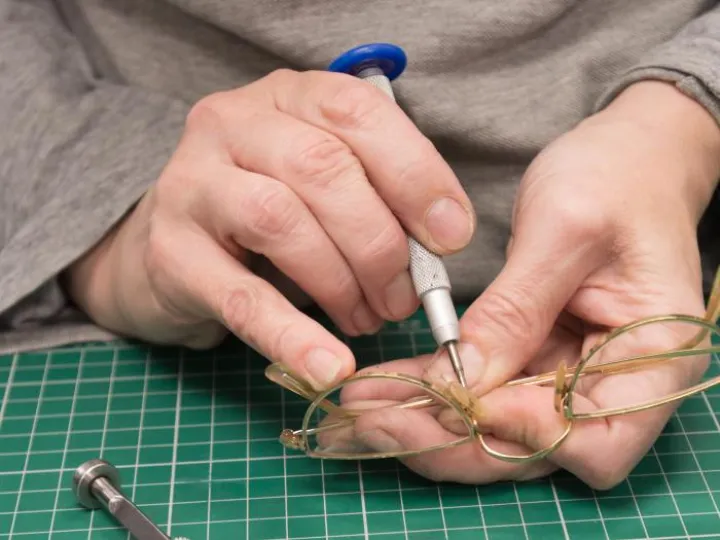
For metal frames, we look closely at the alloy, plating and connection points. Some repairs can be done with laser welding, while others call for soldering, screw replacement or careful mechanical adjustment. Titanium and specialist metal frames require a particularly precise approach to restore strength while protecting the finish and original shape.
Plastic frames require different decisions, such as whether the material can be reshaped, bonded, or reinforced without making the repair bulky. Some breaks can be fixed with careful heat repair, while others require parts replacement or, if the damage is too extensive, a new frame.
We also assess the lenses. If they are high quality, recently prescribed or specially coated, they may be worth preserving; if badly scratched, out of date or mismatched to the wearer's needs, replacement becomes more attractive. Professional assessment helps us decide whether the best value lies in repairing the frame, replacing the lenses, or both.
The real cost of repair
Price is a big reason people consider repair. Glasses are already expensive, especially with prescription lenses. The good news is that many common repairs cost much less than replacing the whole pair. AlphaOmega's prices show most repairs are between £30 and £40, with some jobs costing less and specialist work costing more. This can be a helpful guide: a simple repair may cost less than a new frame alone, not to mention the lenses, and the savings can be even bigger for designer or specialist glasses.
Reglazing sharpens the comparison further. Replacing the lenses can add up quickly, particularly with a specific coating or varifocals, while repairing the frame first can sometimes make a full replacement feel unnecessary.
At the same time, we advise against always choosing the cheapest option. A cheap repair that fails quickly is not good value, whereas a more expensive replacement that lasts longer may be a better investment. Real value comes from durability, comfort, and confidence, not just the price. Turnaround time matters too. If you need your glasses every day, a quick repair may be worth more than a slow replacement.
Common repairs we see every day
Loose or missing screws are probably the simplest problem. A hinge screw can come loose with repeated use, leaving the arm loose or detached. This is often a quick fix, but it still needs to be done properly to keep the screw from coming loose again.
Bent arms are another common issue, making the frame sit unevenly, slide down the nose or press too hard behind the ears. A careful adjustment can usually restore the fit if the material still has enough strength; if the arm is cracked or fatigued, we may need to replace or rebuild it.
Nose pads wear out more often than people expect. They can harden, discolour, or fall out completely, which affects comfort and alignment. Replacing them is a small job that can make a big difference. Many clients tell us they thought the whole frame was failing when all they needed was new pads.
We also see popped lenses, especially in semi-rimless or lightweight frames. If the lens is not damaged, it may be possible to refit it safely. If the frame edge is warped, the repair may be more complicated. Other specialist repairs include hinge rebuilding, bridge repair, soldering, titanium work, and frame straightening.
Repair, replace or reglaze?
Repair and replacement are not always separate decisions. Sometimes the best outcome is to repair the frame and reglaze the lenses; sometimes it is to replace the frame and keep the lenses; sometimes the only sensible route is to start again with a new pair.
We usually suggest clients ask four simple questions: Is the frame still strong? Are the lenses still clear and suitable? Does the pair still fit well? And is the frame worth keeping for cost, style, or sentimental reasons? If most answers are yes, repair usually makes sense. If not, replacement is the better option. This does not mean the glasses are worthless, just that a new frame or pair will serve you better. The main thing is to avoid a repair that will not last. Also, think about how you use your glasses: everyday pairs need to be strong and reliable, while occasional wear might be fine with a lighter repair.
Why repair often feels better
Repair has both practical and psychological benefits. Many customers tell us they feel real relief when a favourite pair is fixed. It's not just about saving money; it's about keeping something familiar and useful.
A well-fitting pair of glasses becomes part of your daily routine and is easy to forget about when everything works. When that pair breaks, it can be surprisingly frustrating. Repair brings back a sense of normal life, and many people are glad they didn't throw their glasses away too soon. This is why spectacle repairs make sense not just financially, but also emotionally and for the environment.
Making the right decision
There is no single rule for every broken pair of glasses. Some frames are perfect for repair, others clearly need replacement, and most are somewhere in between. That's why expert assessment is important. If the damage is minor, the frame fits well, and the lenses are in good condition, repair is usually the smart choice. If the frame is badly cracked or warped, or keeps breaking, a replacement is likely to be better in the long run. The real skill is knowing which option is right for your glasses.
We always advise looking at the whole picture: cost, comfort, vision, fit, durability, and how much you rely on your glasses each day. Repairing a favourite frame can be a great result, and replacing it for clearer vision and better reliability can be just as good. What matters most is choosing the option that works best for you over time. This is the principle we use every day in our workshop, and it's why we often say that spectacle repairs make sense.
STYKE6
More on repairs
Choosing The Best Sunglasses
Glasses That Fit Your Face
How expensive is glasses repair?
Repairing arms on glasses